
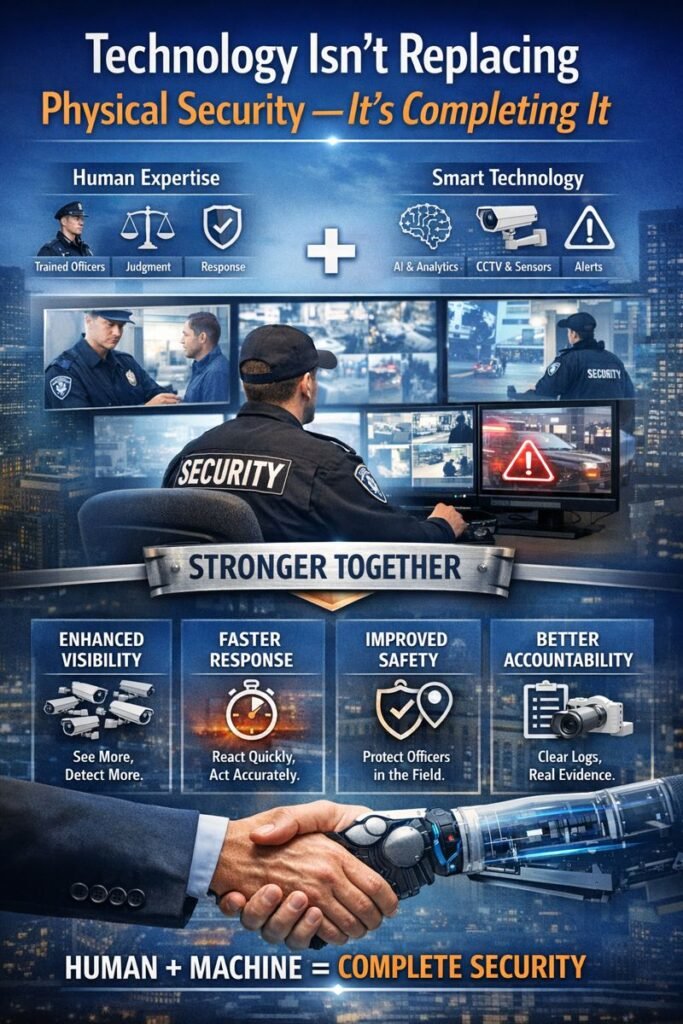
Physical security has always been built on people: trained officers, patrol routines, judgement, presence, and accountability. No system can replace the human ability to assess context, de-escalate situations, communicate with the public, and make ethical decisions in complex, real-world scenarios.
What technology is doing today is not replacing that foundation but strengthening it.
Modern security environments are larger, more complex, and more demanding than ever before. A single commercial building may have hundreds of cameras, multiple access points, different risk zones, and thousands of daily users. Expecting human operators alone to monitor everything continuously is unrealistic and inefficient.
This is where technology complements physical security.
AI-powered video analytics, smart sensors, and digital platforms act as force multipliers. They extend visibility across large areas, monitor continuously without fatigue, and filter out noise so that officers are alerted only when something truly requires attention. Instead of staring at screens for hours, security teams focus on meaningful events and real risks.
This reduces human fatigue and error, improves alertness, and makes security operations more reliable.
Technology also enables faster and more accurate response. Automated detection of intrusion, loitering, smoke, fire, or unusual behaviour allows incidents to be identified earlier, often before they escalate. Systems can instantly provide camera location, event type, time, and context, allowing command centres to dispatch officers with clarity instead of guesswork.
Faster detection leads to faster response, and faster response reduces damage, disruption, and risk to people.
At the same time, technology enhances accountability and professionalism. Digital patrol logs, incident recordings, time-stamped reports, and video evidence increase transparency for clients, regulators, and internal management. Security becomes measurable, auditable, and continuously improvable- not just reactive.
Importantly, technology also improves officer safety. Tools such as real-time location tracking, panic alerts, lone-worker monitoring, and remote situational assessment allow officers to approach incidents more informed and more protected. This makes security work not only more effective, but also safer and more sustainable.
Crucially, technology does not replace human decision-making. It provides information and humans provide judgement. A system may detect a person loitering near a restricted area, but it cannot understand intent, cultural context, or social nuance. Only a trained officer can decide whether to observe, approach, engage, or escalate.
The future of security is therefore not human versus machine. It is human plus machine.
The most resilient and effective security operations today are those that combine professional personnel with intelligent systems, clear procedures, ethical governance, and strong leadership. This partnership creates stronger protection, faster response, better accountability, and safer environments for everyone.
Technology completes physical security by extending human capability and not by replacing it.
#Security #PhysicalSecurity #AI #SecurityTechnology #SmartSecurity #Leadership #RiskManagement