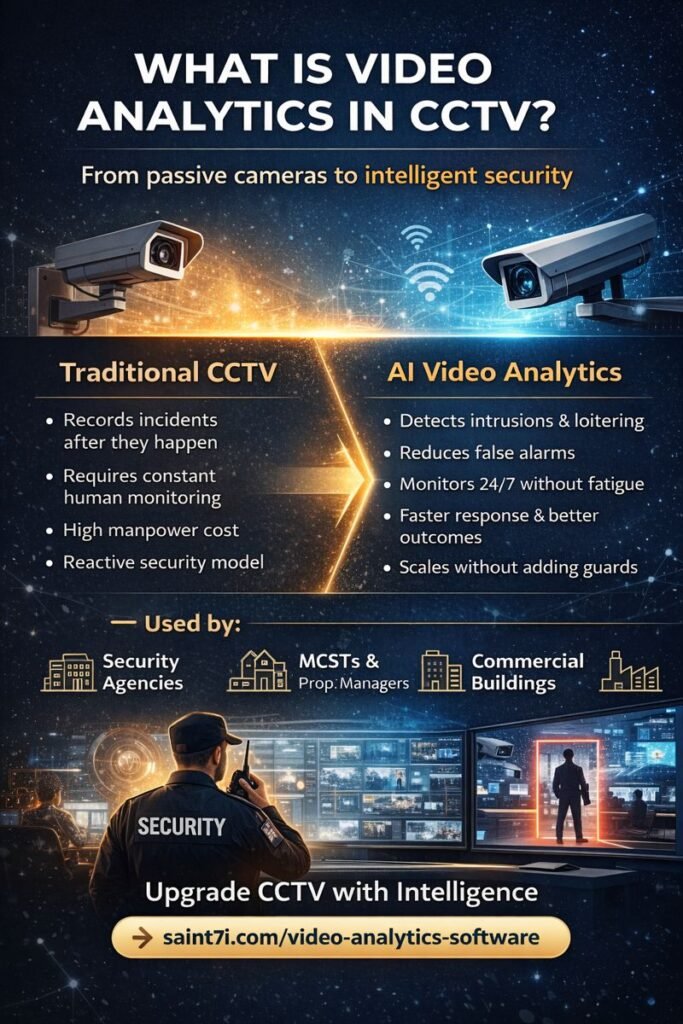
What Is Video Analytics in CCTV & What Can It Be Used For?
Traditional CCTV systems were designed primarily to record video footage for review after an incident occurs. While this has value for investigations, it does little to prevent incidents in real time. As environments become more complex and manpower costs rise, organizations are increasingly turning to video analytics to transform CCTV from a passive recording tool into an active, intelligent security system.
This article provides a comprehensive explanation of what video analytics in CCTV is, how it works, what it can be used for, and why it is becoming essential for modern security operations across businesses, security agencies, and MCSTs.
What Is Video Analytics in CCTV?
Video analytics in CCTV refers to the use of software powered by artificial intelligence (AI) and computer vision to automatically analyze live or recorded video footage. Instead of relying on human operators to continuously monitor screens, video analytics systems interpret video content to detect events, behaviors, and patterns that require attention.
In simple terms, CCTV records video, while video analytics understands what is happening within that video.
Video analytics can operate in real time to generate alerts as incidents occur, or retrospectively to analyze recorded footage more efficiently.
How Video Analytics Works
Video analytics systems typically operate through three core stages.
First, CCTV cameras capture live video feeds as usual. These can be existing IP cameras or new deployments.
Second, AI algorithms analyze the video. These algorithms are trained to recognize people, vehicles, objects, movement patterns, and behavioral cues. Unlike basic motion detection, AI considers context, direction, duration, and interaction.
Third, when predefined conditions are met, the system generates alerts, flags video clips, or notifies operators. This allows security teams to focus on response rather than continuous observation.
What Can Video Analytics Be Used For?
Video analytics has a wide range of applications beyond traditional security monitoring.
1. Intrusion Detection and Perimeter Protection
Video analytics is commonly used to detect unauthorized access to restricted areas. AI can identify when a person enters a defined zone, breaches a perimeter, or accesses an area outside approved hours.
Because AI understands context, it can differentiate between genuine intrusions and harmless movement such as animals or weather effects, significantly reducing false alarms.
2. Loitering and Suspicious Behavior Detection
AI video analytics can identify individuals who remain in an area longer than expected or display unusual movement patterns. This is particularly useful in car parks, lift lobbies, corridors, and building entrances.
Early detection allows security teams to intervene before incidents escalate, improving safety for residents, tenants, and visitors.
3. Reducing False Alarms
One of the most valuable benefits of video analytics is its ability to reduce false alarms. Traditional motion-based systems generate alerts for shadows, lighting changes, or routine activity.
Video analytics focuses on behavior and intent, ensuring that alerts are fewer, more accurate, and actionable. This prevents alert fatigue and improves response effectiveness.
4. Centralised Monitoring and Virtual Guarding
With video analytics, a single monitoring team can oversee multiple sites from a central location. AI continuously monitors all cameras and escalates only verified events.
This enables virtual guarding models where technology performs constant observation and human operators respond selectively, reducing manpower requirements without compromising coverage.
5. Safety Monitoring and Risk Prevention
Video analytics is increasingly used for safety applications. These include fall detection in eldercare or residential environments, smoke and fire detection, unsafe behaviour in industrial settings, and restricted-zone violations.
This expands CCTV from security into proactive safety management.
6. Crowd, Occupancy, and Queue Monitoring
AI can analyze crowd density, people count, and occupancy levels in real time. This is useful for managing congestion, ensuring compliance with safety limits, and improving operational efficiency.
MCSTs and commercial buildings often use these insights to enhance resident experience and safety.
7. Incident Investigation and Evidence Management
When incidents occur, video analytics automatically tags relevant footage, dramatically reducing investigation time. This improves incident reporting, dispute resolution, and compliance documentation.
Who Uses Video Analytics?
Video analytics is widely adopted across multiple sectors.
Security agencies use it to scale operations without scaling manpower. MCSTs use it to enhance safety while controlling costs. Commercial buildings use it to protect tenants and assets. Industrial sites use it for perimeter security and safety compliance. Retail environments use it for loss prevention and operational insights.
Why Video Analytics Is Replacing Traditional CCTV
Traditional CCTV systems rely heavily on human monitoring and post-incident review. This leads to delayed response, higher manpower costs, and inconsistent vigilance.
Video analytics enables proactive detection, faster response, and better resource utilisation. Organisations can upgrade intelligence without replacing existing cameras, making adoption cost-effective.
Video Analytics vs Facial Recognition
Video analytics is often confused with facial recognition, but they are not the same.
Video analytics focuses on behaviour, movement, and events. Facial recognition focuses on identifying individuals. Many video analytics deployments do not use facial recognition at all, making them more suitable for privacy-sensitive environments.
Video Analytics and Privacy Compliance
When deployed responsibly, video analytics can support privacy compliance. By focusing on behaviour rather than identity, limiting data retention, and enforcing access controls, organisations can enhance security while respecting data protection requirements.
Summary
Video analytics in CCTV uses AI to automatically analyze video, detect events, and generate alerts without constant human monitoring. It is used for intrusion detection, loitering detection, false-alarm reduction, safety monitoring, crowd analysis, and centralised security operations.
Conclusion
Video analytics transforms CCTV from a passive recording system into an intelligent security platform. As security challenges grow and manpower constraints increase, video analytics is becoming a core component of modern security strategies.
For businesses, security agencies, and MCSTs, adopting video analytics is no longer optional. It is a strategic step toward safer, more efficient, and future-ready security operations.